MDCAT: pattern, syllabus and passing marks
MDCAT is the entry test for MBBS and BDS admission in Pakistan. PM&DC sets the syllabus and rules, and a university in each province conducts the test. These facts are from MDCAT 2026, the latest edition; no MDCAT 2027 announcement had been made when this page was checked.
Checked against the official sources below on 21 October 2026.
At a glance
| Regulator | Pakistan Medical and Dental Council (PM&DC): sets the syllabus and rules and registers candidates[1][2] |
|---|---|
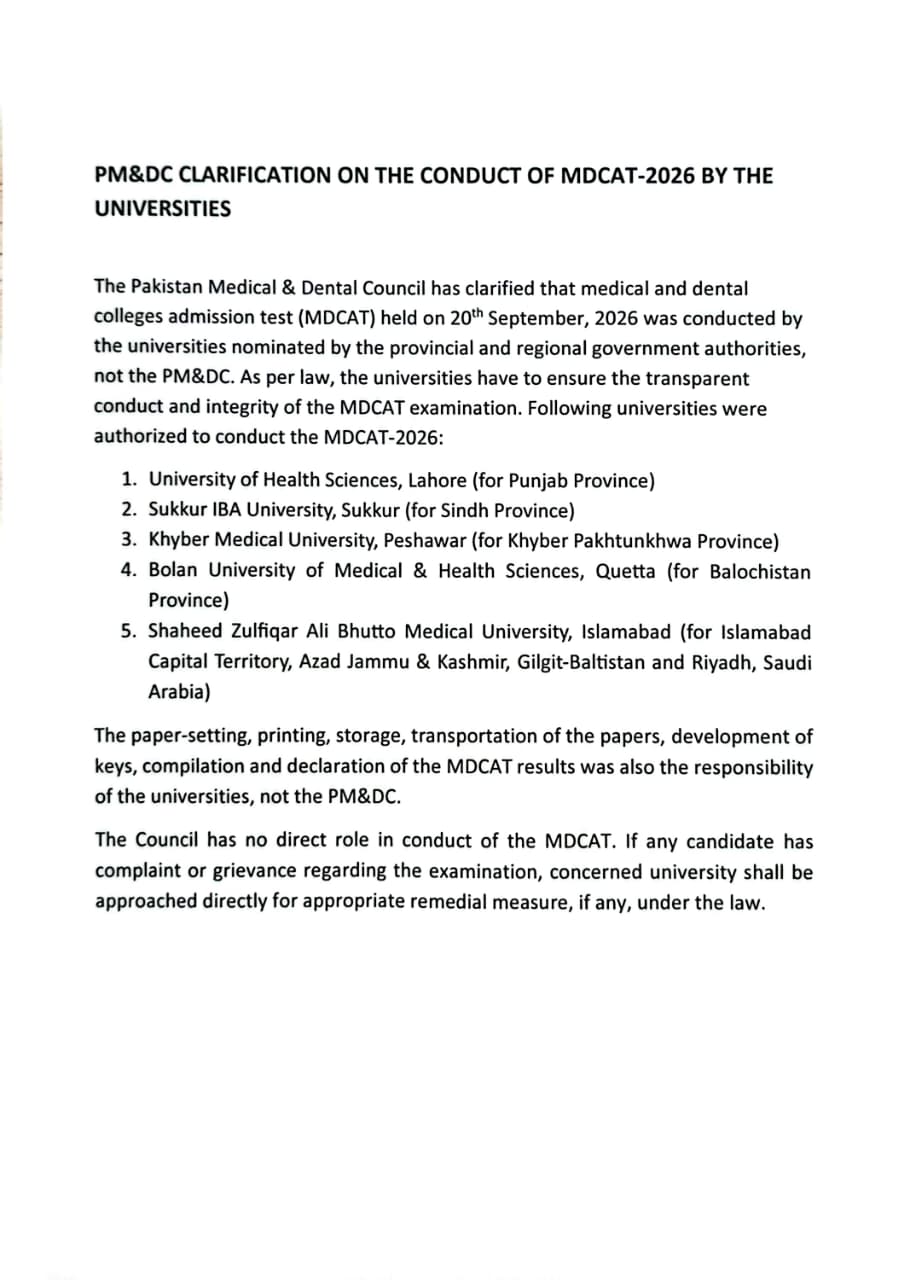
| Conducted by (2026) | UHS Lahore (Punjab), Sukkur IBA University (Sindh), Khyber Medical University (KP), Bolan University of Medical and Health Sciences (Balochistan), and Shaheed Zulfiqar Ali Bhutto Medical University (Islamabad, AJK, Gilgit-Baltistan and Riyadh)[2] |
| Questions | 180 MCQs, on paper, in English[3] |
| Subject split | Biology 81 (45%), Chemistry 45 (25%), Physics 36 (20%), English 9 (5%), Logical Reasoning 9 (5%)[3] |
| Time | 3 hours[4] |
| Negative marking | None[3] |
| Marking | One mark per question, 180 in total, with four options per question (as stated in UHS Lahore's guide for Punjab)[5] |
| Difficulty | 15% easy, 70% moderate, 15% difficult[4] |
| Passing marks | 55% for MBBS, 50% for BDS[4][6] |
| Result validity | Three years from the test[5][7] |
| Merit formula (public colleges) | MDCAT 50%, FSc/HSSC 40%, Matric/SSC 10%[8] |
| Eligibility | Pass the MDCAT and have FSc/HSSC or equivalent with at least 60% marks, with Biology and Chemistry plus Physics or Mathematics[8] |
| MDCAT 2026 date | Sunday 20 September 2026 (moved from 16 August 2026)[9] |
| MDCAT 2026 fee | PKR 9,000 for centres in Pakistan; PKR 45,000 for the international centre[3] |
Syllabus
PM&DC's official MDCAT curriculum (2025, which PM&DC applied to MDCAT 2026) lists these units. Each unit in the curriculum document has detailed learning outcomes.
Biology[4]
- Acellular life
- Bioenergetics
- Biological molecules
- Cell structure and function
- Coordination and control / nervous and chemical coordination
- Enzymes
- Evolution
- Reproduction
- Support and movement
- Inheritance
- Circulation
- Immunity
- Respiration
- Digestion
- Homeostasis
- Biotechnology
Chemistry[4]
- Introduction of fundamental concepts of chemistry
- Atomic structure
- Gases
- Unit 4: properties of liquids (the curriculum gives this unit no title)
- Solid
- Chemical equilibrium
- Reaction kinetics
- Thermochemistry and energetics of chemical reaction
- Electrochemistry
- Chemical bonding
- S- and P-block elements
- Transition elements
- Fundamental principles of organic chemistry
- Chemistry of hydrocarbons
- Alkyl halides
- Alcohols and phenols
- Aldehydes and ketones
- Carboxylic acids
- Macromolecules
- Industrial chemistry
Physics[4]
- Vectors and equilibrium
- Force and motion
- Work and energy
- Rotational and circular motion
- Fluid dynamics
- Waves
- Thermodynamics
- Electrostatics
- Current electricity
- Electromagnetism
- Electromagnetic induction
- Alternating current
- Electronics
- Dawn of modern physics
- Atomic spectra
- Nuclear physics
English[4]
- Reading and thinking skills
- Formal and lexical aspect of language
- Writing skills
Logical Reasoning[4]
- Critical thinking
- Letter and symbols series
- Logical deductions
- Logical problems
- Course of action
- Cause and effect
Good to know
- PM&DC confirmed that the 2025 curriculum applies to MDCAT 2026; no separate 2026 syllabus was issued.[10]
- You sit the test in your own province or region of domicile. In 2026, Sindh candidates could also choose an Islamabad centre.[3]
- In 2026 each conducting university set its own paper from a common PM&DC question bank of about 8,000 questions.[2][11]
- MDCAT 2026 had 138,158 registered candidates, with centres in 34 cities and towns plus Riyadh, Saudi Arabia.[12]
Practise for MDCAT
Chapter-wise MCQs for Biology, Chemistry and Physics, marked instantly with an explanation.
Practise MDCAT questionsSources
- PM&DC press release: arrangements for MDCAT (18 September 2026)
- PM&DC: Clarification on the conduct of MDCAT 2026 (image)
- PM&DC: Public notice on the MDCAT 2026 registration portal
- PM&DC: MDCAT curriculum 2025, final (PDF)
- UHS Lahore: MDCAT 2026 essentials (PDF)
- Khyber Medical University: admissions
- PM&DC press release: universities, not PM&DC, responsible for MDCAT papers
- PM&DC (Admissions, Curriculum and Conduct) Policy and Regulations 2026 (PDF)
- PM&DC: MDCAT 2026 rescheduling notice
- PM&DC: Public notice on the MDCAT 2026 date
- PM&DC press release: Health Minister's press conference on MDCAT 2026 (16 September 2026)
- PM&DC press release: MDCAT exam centre visit (20 September 2026)
Waraq is an independent study platform, not affiliated with PM&DC or any university. Exam rules change from year to year: always confirm with the official source before you register or apply.